Black and white, but never plain: Zebra Soft Toys and Plush Toys for savannah enthusiasts
Zebras as Soft Toys: Africa's striped horse relatives in the Carl Dick Collection
Manes, hooves and individual stripes shape the Zebra Cuddly Toy
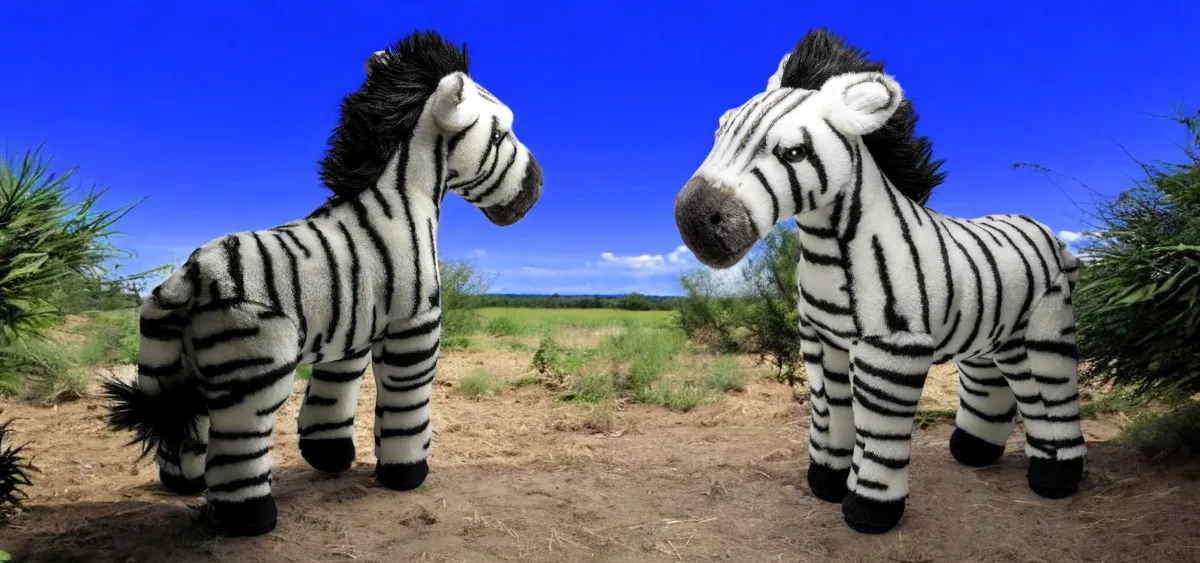
A zebra has a silhouette that stands out immediately even among many hoofed animals. The elongated head, large mobile ears, powerful neck, long legs and short upright mane reflect its relationship with horses and donkeys. At the same time, the black-and-white pattern gives every animal an unmistakable appearance. The stripes extend across the head, neck, body and legs and vary in width and density between zebra species. The tail is another characteristic feature: its upper section carries relatively short hair, while a dark tuft appears at the end. For a Zebra Cuddly Toy, these details matter more than exaggerated facial features. A Plush Toy can appear friendly and approachable while clearly preserving the mane, ear position, hooves and stripes. As a Soft Toy, the zebra therefore remains easy to recognise beside horses, giraffes and antelopes. Zebra Cuddly Toys appeal to children looking for a distinctive character for savannah stories, as well as adults who collect Plush Toys with clear animal shapes and graphic coat patterns.
Grasslands, scrub and mountain slopes offer zebras different routes
Zebras occur naturally in Africa and use remarkably different landscapes according to species. Plains zebras live mainly in open grasslands, savannahs and lightly wooded areas where enough grass and accessible water are available. Mountain zebras move confidently across dry plateaux, stony slopes and rocky regions of south-western Africa. Grevy's zebras are particularly associated with dry grasslands and scrub in eastern Africa. Despite these differences, all zebras are herbivores. Grasses form the largest part of their diet, while leaves, bark and young plant material may also be eaten according to the season. The animals sometimes travel considerable distances in search of fresh grazing and water. Their firm hooves carry them across dry ground, grassland and rocky routes. A zebra as a Soft Toy can therefore evoke several African settings. The Cuddly Toy belongs naturally in a broad savannah, a rocky mountain landscape or a dry scrub plain. The Plush Toy gains a varied habitat connection that reaches beyond its familiar black-and-white coat.
Group structure, calls and watchful ears shape daily life
Zebras are social animals, although their groups differ between species. Plains and mountain zebras often live in stable family units consisting of one stallion, several mares and their young. Grevy's zebras generally form looser groups whose composition can change with food, water and the breeding season. While grazing, the animals remain attentive and use sight, hearing and scent to detect changes around them. Mobile ears show not only the direction of a sound, but also support communication within the group. Zebras also communicate through whinnies, barking calls, snorts, posture and facial expression. During periods of rest, one animal may remain alert while others lie down or doze. Foals orientate themselves towards their mothers from an early age and learn to recognise their scent, voice and stripe pattern. Mutual grooming also strengthens social relationships and reaches parts of the body that one zebra cannot easily maintain alone. These behaviours give a Cuddly Toy believable roles as an attentive herd companion, inquisitive young animal or watchful resident of a small Plush Toy savannah.
Zebra and okapi at Plueschtier.de: two striped motifs, two different animals
At Plueschtier.de, this subcategory currently presents a standing zebra and an additional okapi from the Carl Dick Collection. The Zebra Soft Toy places the familiar black-and-white pattern, upright mane, elongated head and tall legs at the centre of its design. The standing posture keeps the complete silhouette clearly visible and creates a defined focal point within a wildlife collection. Although the accompanying okapi also has striking stripes across its legs and hindquarters, it is not a zebra. It belongs to the giraffe family and naturally inhabits the dense forests of Central Africa. Its dark brown body, large ears and striped legs distinguish it clearly from the zebra. This comparison makes the focused selection especially interesting because two African Soft Toys with striped motifs appear together without representing the same animal group. Children can take the Zebra Cuddly Toy across an open savannah and place the okapi in a woodland story. Adults discover two Plush Toys whose patterns look similarly striking, yet whose build, habitat and family relationships create entirely different animal portraits.
Did you know...
There are three living zebra species: the plains zebra, mountain zebra and Grevy's zebra, which differ visibly in build, habitat and stripe width. No two zebras have exactly the same stripe pattern, allowing individual animals to be recognised by their markings. The short mane stands upright and does not form the forward-falling forelock seen on many domestic horses. Zebras belong to the horse family and, like horses and donkeys, stand on one weight-bearing toe bone on each foot, surrounded by a firm hoof. A healthy foal can stand and walk shortly after birth, enabling it to follow its mother and the group.
Strongly striped Soft Toys for children, collectors and African animal worlds
A zebra as a Soft Toy suits people who appreciate clear animal shapes and expressive coat patterns. For children, the Cuddly Toy can stand nearby during reading, accompany an imagined journey to a waterhole or join lions, elephants, giraffes and further Soft Toys in a varied savannah world. The upright posture suits a watchful role, while the black-and-white stripes keep the animal immediately visible within a larger group. Adults often choose Zebra Plush Toys as gifts for admirers of Africa, reminders of a memorable animal sighting or graphically striking accents within wildlife collections. The additional okapi opens up a second African landscape and invites comparison between two completely different striped animals. Several Plush Toys can be arranged by habitat, body shape or personal favourite. One Zebra Cuddly Toy also feels complete through its mane, ears, hooves and individual stripe pattern. The Carl Dick Collection at Plueschtier.de brings animal knowledge, play ideas and decorative appeal together in a category where black and white appear anything but plain.