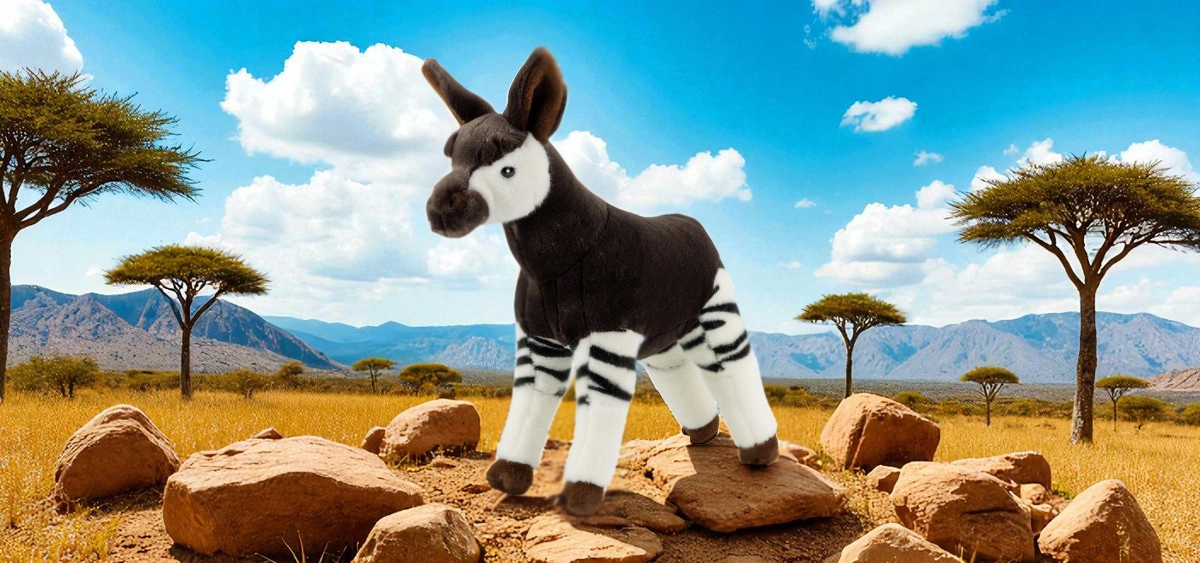
Okapi Soft Toys and Plush Toys – Striped Legs on Quiet Trails Through the Congolese Rainforest
Okapi Soft Toys from the Carl Dick Collection Portray the Rainforest's Striped Giraffe Relative
Large Ears and a Velvety Brown Coat Give the Okapi Its Unmistakable Face
An okapi appears familiar and surprising at the same time. The dark-brown body, pale striped legs, elongated head and large upright ears create an animal shape clearly distinct from other inhabitants of forests and open country. As a Cuddly Toy, this rarely represented rainforest animal becomes an approachable companion for children, adult animal enthusiasts and collectors. An Okapi Cuddly Toy can travel through an imagined woodland landscape, find a sheltered trail among cushions or join other Cuddly Toys in a varied animal group. On a shelf, sofa or desk, an Okapi Plush Toy instead creates a distinctive accent because the black-and-white stripes across the hindquarters and legs attract attention immediately. Several Plush Toys inspired by African wildlife can form a varied collection, whilst one Soft Toy may deliberately stand on its own. Head position, ear angle and the arrangement of the leg stripes determine whether the figure appears attentive, cautious or curious. The okapi therefore develops a clear personality as a Soft Toy without losing the distinctive body shape that makes it so easy to recognise.
In the Dense Congolese Forest, Keen Hearing Guides Every Step
Okapis live in the dense tropical forests of the Democratic Republic of the Congo. High canopies, thick undergrowth and patches of filtered light shape an environment where careful orientation matters more than a broad view across open ground. The large mobile ears collect subtle sounds from different directions and help the animal notice changes in the forest at an early stage. Okapis usually travel alone and often follow familiar paths through the vegetation. When feeding, they use the long tongue to draw in leaves, buds and young twigs from shrubs and lower trees. Fruit and fungi can also form part of the diet. Their daily routine alternates between unhurried walking, concentrated browsing and sheltered periods of rest. This reserved way of life makes encounters with a living okapi uncommon, yet gives the animal motif considerable storytelling depth. An Okapi Soft Toy can recall a quiet moment of observation among leaves, whilst a Plush Toy in imaginative play explores the next woodland trail. The Cuddly Toy therefore connects the idea of dense rainforest with an animal that moves through its surroundings attentively and without unnecessary haste.
A Prehensile Tongue, Striped Legs and Mobile Ears Explain Its Forest Adaptations
The okapi belongs to the same animal family as the giraffe, yet it has a much shorter neck and more compact proportions. This body shape makes movement between branches, trunks and dense vegetation easier. The long, dark prehensile tongue is especially versatile. It draws leaves closer, removes young growth from twigs and can even reach the areas around the eyes and ears during grooming. The large ears can move independently and support precise awareness in a visually restricted forest. The coat also suits the surroundings: the brown body blends with shaded vegetation, whilst pale horizontal stripes across the legs and hindquarters echo the broken pattern of light and shadow. Male okapis usually carry short, skin-covered horn-like structures on the head; females generally have no clearly visible equivalents. In a Plush Toy, these features create an easily understood design language. An elongated head, upright ears, sturdy body and carefully positioned stripes turn a general hoofed-animal figure into a convincing Okapi Soft Toy. Different Soft Toys could emphasise individual details in different ways and still remain instantly recognisable as okapis.
At Plueschtier.de, the Upright Okapi Silhouette Takes Centre Stage
This subcategory at Plueschtier.de is devoted to the okapi as a Cuddly Toy, Plush Toy and Soft Toy from the Carl Dick Collection. The carefully focused selection centres on an upright standing interpretation, allowing the long legs, striped hindquarters, dark-brown body and large ears to remain clearly visible. A standing pose presents the distinctive relationship between the sturdy torso, slimmer limbs and slightly extended head particularly well. When considering the figure, you can notice how the stripes are arranged across the legs and rear body, how the ears are positioned and what effect is created by the angle of the head. For children, an Okapi Cuddly Toy can become a companion for personal rainforest stories. Adults may choose the Okapi Plush Toy as an unusual focal point, a reminder of an animal encounter or an addition to a wildlife collection. Beside giraffes, zebras, forest antelopes and other Soft Toys, the okapi retains an identity of its own because its features do not merge into an interchangeable mixed form. The Carl Dick Collection gives this uncommon Plush Toy motif enough space for its characteristic silhouette to make an impression within a deliberately clear category.
Did you know...
The okapi is the giraffe's closest living relative. In the wild, it occurs only in the rainforests of the Democratic Republic of the Congo. Its dark prehensile tongue is long enough to strip leaves and even reach the eyelids and ears. Male okapis usually carry short, skin-covered horn-like structures, whilst females generally have no clearly visible equivalents. Young okapis often spend their first weeks in a sheltered hiding place where the mother visits them between feeding journeys. These five facts show how closely anatomy, habitat and behaviour work together in this forest animal. An Okapi Cuddly Toy highlights the large ears, elongated head and striped legs, whilst the Plush Toy captures the animal's reserved way of life in a permanently visible figure. Anyone looking more closely at a Soft Toy can therefore discover not only an unusual coat pattern, but also starting points for conversations about giraffe relationships, forest adaptations and the early lives of young okapis.
An Okapi Soft Toy Begins a Rainforest Story Beyond Familiar Animal Classics
An Okapi Soft Toy suits people who appreciate unusual wildlife, clearly defined coat patterns and animal motifs with a distinctive natural history. Children can give their Cuddly Toy a name, create a woodland trail from blankets or send it through dense undergrowth on an imagined journey with other Cuddly Toys. The okapi may emerge carefully between leaves, search for food beside a clearing or guide a small animal group through the rainforest. Adults may connect an Okapi Plush Toy with a journey, a visit to an animal park or an interest in rarely represented giraffe relatives. As a gift, the motif feels personal because the striped legs, large ears and dark-brown coat create an instantly recognisable character. Within a collection, this compact giraffe relative provides a clear contrast with towering giraffes, boldly striped zebras or powerful elephants. Several Plush Toys can form a varied African animal world, whilst one Soft Toy makes a deliberate statement through its unusual silhouette. The okapis in the Carl Dick Collection leave room for imagination, memories and the pleasure of collecting, turning a reserved forest animal into a companion whose distinctive shape remains memorable.